




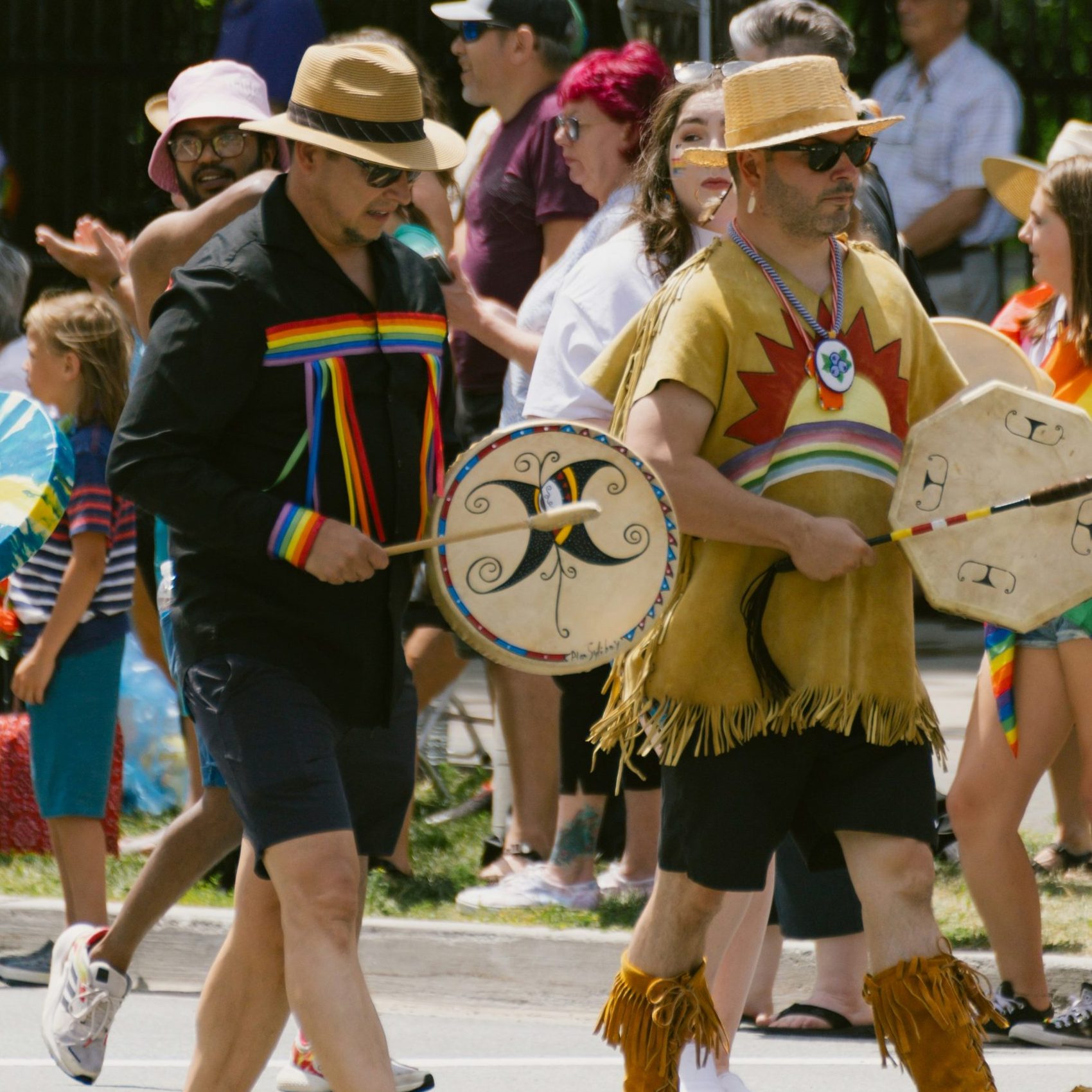
Drummers from the Wabanaki Two Spirit Alliance in the 2022 Halifax Pride Parade. Photo by Jan Budomo on Unsplash.
Advocating for Pride matters
June is International Pride Month and NSCSW recognizes the importance of supporting and advocating for 2SLGBTQIA+ rights and freedoms. What does this mean at a time of rising anti-2SLGBTQIA+ hate and violence? Since 2016 reported hate motivated crimes against 2SLGBTQIA+ people in Canada has risen by 388% (Egale, 2024). “In recent years, Canada witnessed an increase in anti-trans policies and policy proposals from municipal, provincial and federal levels of government.” (Egale, 2024). We are watching in real time the erosion of protections for queer people and growing social polarization, especially related to transgender identity & expression. The world is becoming less safe for queer and trans people. You only need to look at comments under International Pride month posts on social media to see how real and present the hate is. Social workers have a role to play in creating safer, affirming, and joyful spaces for 2SLGBTQIA+ people and communities
Social work ethics & 2SLGBTQIA+ rights
In our Code of Ethics and Standards of Practice, Nova Scotian social workers are called to respect the dignity and worth of all people and promote and advocate for social justice, including:
- advocating for the rights and freedoms of 2SLGBTQIA+ communities to express their gender identity
- recognizing the diversity that exists in Nova Scotian communities, including 2SLGBTQIA+ Nova Scotians, both service users and social workers
Social workers advocate for the rights of all individuals, families, groups, and communities to be free from oppression, exclusion, and discrimination. Social workers cannot be passive in addressing the rise of anti-2SLGBTQIA+ hate. They have a duty to call out injustice wherever they see it, especially in their places of work and in community.
Challenging neutrality & heteronormativity
Many of the anti-2SLGBTQIA+ policies and practices being implemented across the country are rooted in white supremacist and colonial assumptions and beliefs related to neutrality. There is a dominant belief that heteronormative beliefs are the norm. It is common to hear people talk about the need for protecting children and young people from 2SLGBTQIA+ ideologies, without accounting for the dominance of heteronormative values and beliefs throughout society. Social workers in Nova Scotia in health, private practice, government, education, and community development must resist this way of thinking and challenge their peers and community to do better.
Centring queer joy in practice
NSCSW takes an active role in supporting safe(r), affirming, and joyful spaces for 2SLGBTQIA+ social workers and service users. In April we kicked off our closed communities of practice space for 2SLGBTQIA+ social workers, and asked social workers, “How are you fostering/experiencing queer joy in your social work practice?” Social workers responded by saying:
- “I love that I can create space for young people to see so many different representations of queerness and then they can find who they are and feel good and strong. Helping them to understand that it’s not one size fits all and just because you don’t “look queer” doesn’t mean you aren’t part of this community,”
- “While my work isn’t queer in and off itself, I do get to BE queer in these spaces, which helps me.”
- “I enjoy celebrating queer experiences. Not simply focusing on the traumatizing experiences, but also the strength of the community. I find that I feel most proud and hopeful when I listen to queer youth and get to encourage their art work!”
Imagining the future of Queer Joy
When the participants were asked, “What is your future vision for Queer Joy in social work practice,” participants responded by saying:
- “My future vision for Queer joy involves acting as active collaborators rather than having a position of a gatekeeper involving resources. I want to be a bridge or a teammate rather than an expert in someone else’s experience.”
- “Continuing to have queer-focused events and spaces in social work that focus on both us as queer social workers and on positive aspects of queerness for our clients. I’ve seen studies on queer community and how queer spaces can help connect people to care in ways that aren’t the most feasible in bigger systems (e.g. ballroom culture in Montreal).”
- “Policies and systems that are focused on liberation and joy. more active stances against queerphobia and transphobia.”
Upcoming events: An invitation
NSCSW has two upcoming sessions taking place in July which centre 2SLGBTQIA+ voices:
- Check me out – Sexual Health in NS on Monday July 13 at 12:00 p.m. offers an overview of the Check Me Out tool and resources for 2SLGBTQIA+ sexual health.
- Connections: Queering social work takes place on Thursday July 16 at 12:00 p.m. This is our second closed communities of practice session for 2SLGBTQIA+ social workers this year; this series seeks to hold space for 2SLGBTQIA+ social workers to discuss ethics, practice issues, and build connections for safe(r) social work practice.
Nearly every week of the summer has a Pride celebration happening somewhere in Nova Scotia. If you’re planning an event that gives social workers an opportunity to learn, connect, and become better advocates, please leave a comment on this page or submit a listing for our member newsletter.
A call to advocate for justice and joy
Despite the rise of growing anti-2SLGBTQIA+ hate, queerness is an invitation to see beyond the dominance present within our systems, policies, and practices. Queerness pushes against heteronormative ideas and assumptions, recognizing and acknowledging diversities of gender identities and sexual orientation.
This International Pride Month, NSCSW calls on social workers to advocate for and promote social justice and joy for 2SLGBTQIA+ people and social workers. It is not only ethically and morally right, it is essential for working against dominant forces that oppress not just 2SLGBTQIA+ people, but all of us.